Keeping Seahorses in an Aquarium
Contents
The seahorse is an exotic animal that is rarely grown in an aquarium because… Most species can only live in clean salty liquid: in a freshwater environment they quickly die. Difficulties arise when creating the necessary conditions and selecting a diet.
.jpg)
General description
Seahorses are primitive creatures. They belong to the genus of small marine ray-finned fish of the order Acicularis. 57 species have already been described.
Seahorses have an unusual appearance: their body length is 5-20 cm, depending on the species. The fish’s head has an elongated shape, reminiscent of a horse’s muzzle, and the oral apparatus is represented by an elongated tube. The animals have large round eyes that can move independently of each other, giving a 300° field of view. In the cheek area there are plates that protect the gills from mechanical damage. In addition, there are often growths on the animal’s head, which only enhance the resemblance to a horse.
The head is attached to the curved body due to the long neck. The abdominal area is slightly thickened. There is a large fin on the back. The body has an elongated, slightly laterally flattened shape. The long tail is curled into a ring: it can be used to cling to branches and aquatic plants.
At the junction of the head and neck there is a pair of short fins. The basis of the body is an exoskeleton, covered not with scales, but with special skin.
Seahorses come in the following colors:
- yellow;
- blue;
- green;
- red;
- black and white;
- brown.
Speckled or striped coloration is common. Growths on the animals’ heads and backs make them invisible among rocks, corals and algae. The swim bladder is located along the entire body. Inside it is divided by a partition. In this case, the head part of the bladder is larger than the abdominal part.
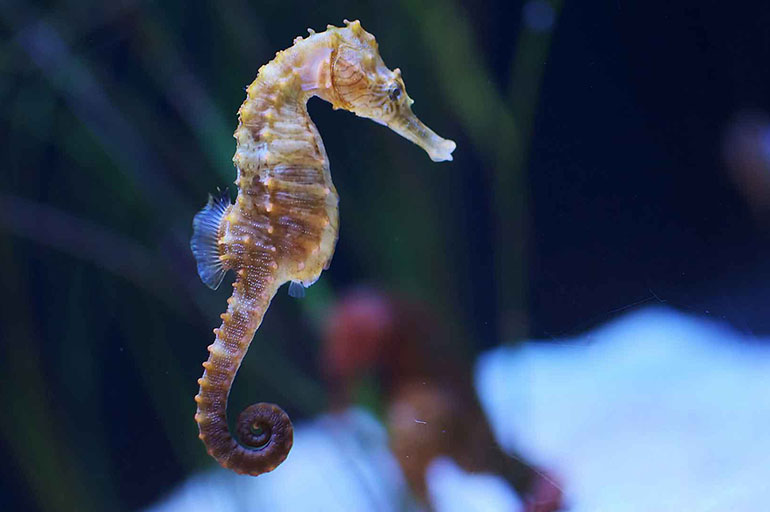
The digestive system of seahorses is extremely primitive: they do not have a stomach. Nutrients are absorbed as food passes through the intestinal tube. The animals spend most of their lives catching food from the water; in natural conditions they feed on small shrimp and crustaceans.
Seahorses swim almost vertically, move little and slowly. Only when very frightened can they accelerate slightly by increasing the frequency of fin flapping up to 35 times per second. They spend most of their lives between stones or aquatic plants.
What varieties are available for the aquarium?
Seahorses caught in the wild are not suitable for pet keeping. Such creatures, when moved to an aquarium for 2-3 months, die from infections or exhaustion, because They are extremely reluctant to switch to frozen food.
The population bred in captivity is more stable. Such animals are in good health and can consume frozen food. In addition, they adapt to the aquarium more easily than their relatives that appear in nature.
The following types of seahorses are in demand among breeders:
- H.reidi.
- Hippocampus erectus.
- H.barbouri
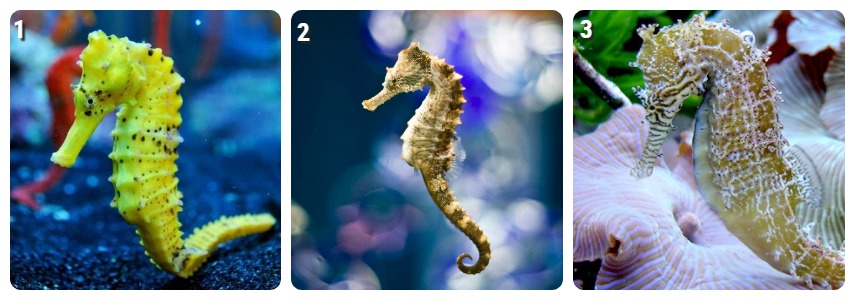
These fish are well adapted to keeping and breeding in home aquariums. They rarely suffer from infectious diseases.
House conditions
To introduce animals into an already formed ecosystem, you need to take into account many factors:
- Seahorses require vertical space, so it is worth purchasing a new aquarium for them with a container height of more than 45 cm.
- The water temperature should be +17.7 °C…+25.5 °C depending on the type. The recommended water acidity is 8.1-8.3 pH, and the density is 1.021-1.024. The presence of phosphates and ammonia is unacceptable. Nitrate levels should not exceed 10 ppm. At least 2 times every 30 days you need to replace ¼ of the water in the aquarium.
- To maintain the conditions necessary for seahorses, high-quality filtration is required. It is better to use skimmers: they saturate the water with oxygen, but do not create a strong current that can become an obstacle to the normal movement of seahorses.
- Fish require dim lighting.
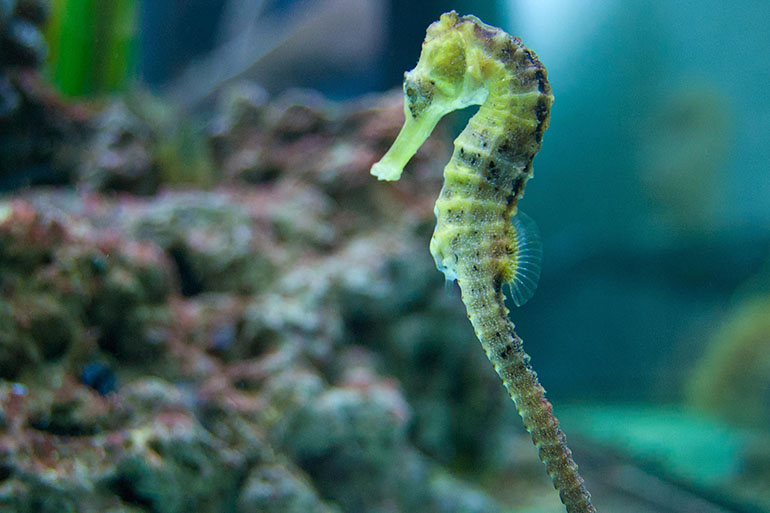
- In the aquarium you need to plant plants that produce long leaves. The algae Caulerpa prolifera is often used for landscaping. It grows quickly, creating labyrinths that become a home for fish. Additionally, you can install artificial corals and stands to which the animals will cling with their tails.
Diet and feeding frequency
Breeders are often faced with the problem of what food to give their seahorses.
When kept in captivity, it is recommended to feed the animals frozen Mysis shrimp. Seahorses consume food slowly, devoting almost the entire day to this activity.
It is best to install a special feeder and give food 2 times a day. In one meal, a seahorse eats up to 6-8 shrimp. Large individuals can consume up to 10 pieces. If the seahorse missed the shrimp, it must be drawn in with a syringe and placed back in the feeder.
Often, seahorses are not able to find the feeder on their own. To accustom animals to it, you need to give them food with tweezers. The shrimp should be taken by the tail, lowered into the water in front of the seahorse and waved a little to attract the animal’s attention to the feeder. Just a few such procedures are enough for the animals to get used to the place where they receive food.
Breeding in captivity
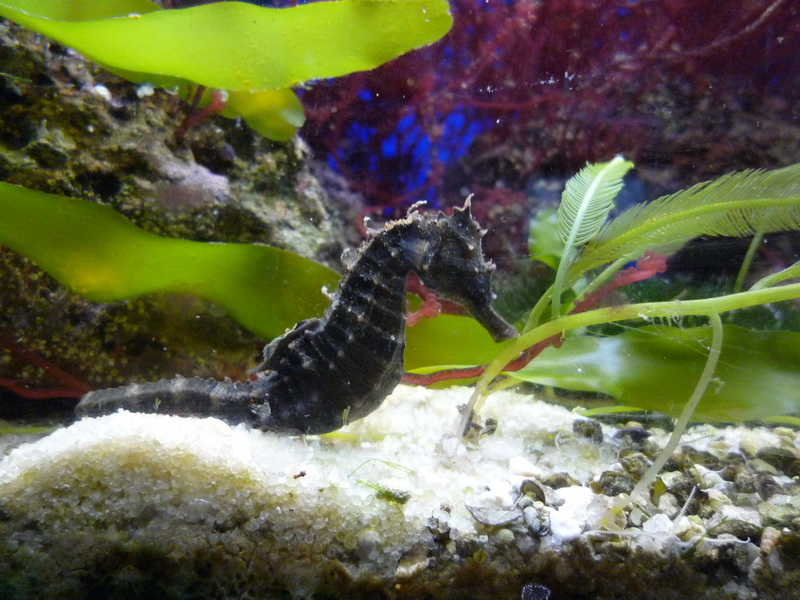
Obtaining offspring in captivity is only possible if the animals living in the aquarium were able to create pairs. Pipits are believed to be monogamous: females lay eggs, but the male takes care of them. Animals give birth once a year.
During the mating season, the male begins to circle around his partner. The female, ready for reproduction, spins around in one place. This ritual can be repeated for more than a week.
When both partners are ready to breed, the female begins to rise up and the male should not lag behind her. Her ovipositor enlarges, and her partner’s pouch opens. The female then begins laying eggs, carefully placing the eggs in the male’s pouch until it is full. Up to 600 eggs can be laid at one time.
Over the next month, the male carries the offspring. By the end of the period, fry appear, which are an exact copy of the parents, but their body is transparent and devoid of colors. The young strive to cling to any surface. Most often they connect with each other, feed on plankton and grow quickly.
Safe Neighborhood
Many breeders believe that it is better to keep seahorses in a separate aquarium without neighbors. This will make caring for them easier and reduce the risk of infection and parasites. However, if you wish, you can choose safe neighbors for them.
The following fish are placed in the aquarium with the seahorses:
- blennies;
- cardinals;
- royal scales;
- bulls
You can add snails to the aquarium. Small species of hermit crabs will also be good neighbors for seahorses.
Previous

Spelling error report
The following text will be sent to our editors: